+91 8008100192
 +1 (855) 650-4040

Introduction: The AMC Nobody Reads Until They Need It
An Annual Maintenance Contract for a website is usually signed in the same meeting as the invoice, a formality tacked onto a build or redesign project, initialled without much scrutiny. That's fine right up until a payment gateway fails on a Friday evening, or a core update breaks the homepage, and the business discovers that "maintenance" in the contract meant nothing more specific than "we'll take a look at it sometime."
Government and institutional AMC tenders in India hospitals, banks, universities are, perhaps surprisingly, often more precise about scope than the contracts small and mid-sized businesses sign with agencies. Those tenders routinely spell out SLA guarantees, security-incident response, and source-code handover obligations in writing. A private business deserves the same clarity, not because its website is less important, but because the cost of an undefined contract lands entirely on the business, not the vendor.
This piece lays out what a website maintenance contract AMC should actually include in India in 2026, based on how serious providers structure them and where the vague ones leave businesses exposed.
What an AMC Is (and Isn't)
A website maintenance contract, or AMC, is a yearly (sometimes quarterly or monthly-billed) agreement between a business and a service provider covering the ongoing technical upkeep of a website: updates, backups, security, uptime monitoring, and a defined level of support. It is not a project contract; it doesn't cover a redesign, a new feature build, or a rebrand. Confusing the two is one of the most common reasons businesses feel shortchanged: they expect ongoing development inside a maintenance budget that was only ever priced for upkeep.
In India, basic website care plans typically run from roughly ₹2,000 to ₹5,000 a month for core updates, backups, and monitoring, with standard plans that add content changes and performance tuning running higher. The number matters less than what sits behind it: a ₹3,000/month AMC with a clear SLA is worth more than a ₹10,000/month one with none.
The Core Scope Every Website Maintenance Contract Should Define
A complete AMC should answer five questions in writing, not by implication:
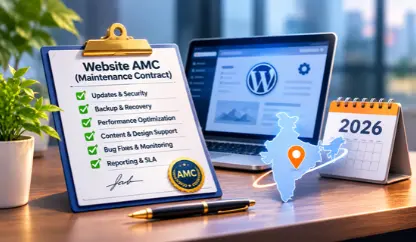
1. What's actually covered. CMS core, theme, and plugin updates; security patching and malware scanning; SSL certificate renewal; off-site backups and restore testing; uptime monitoring; broken-link and 404 checks; and a defined number of minor content or text changes per month. If e-commerce is involved, payment gateway and checkout monitoring need to be named explicitly; "website maintenance" and "WooCommerce maintenance" are not interchangeable scopes, and treating them as one is how checkout bugs sit unnoticed for weeks.
2. What's excluded. A good contract lists exclusions as clearly as inclusions: new feature development, third-party plugin licensing costs, major redesigns, content migrations, and anything requiring more than an agreed number of hours per month. Vague agreements fail here first: when nothing is excluded on paper, nothing is really guaranteed either.
3. Response and resolution times by severity, not in general. "We respond quickly" is not a commitment; a table is. A workable structure most providers use:
| Severity | Example | Response Time | Resolution Target |
|---|---|---|---|
| Critical (site down) | Server crash, hack, checkout broken | 1–4 hours | Same day |
| High | Major feature broken, security alert | 4–8 business hours | 24–48 hours |
| Normal | Minor bugs, small content updates | 1 business day | 2–5 business days |
Without this table, "response time" defaults to whenever the vendor gets around to it.
4. Uptime commitment and what happens if it's missed. 99.5% uptime is a reasonable baseline for most business sites; 99.9% is the standard for anything transactional. The number alone isn't the protection; the remedy is. Contracts worth signing specify a service credit (commonly a percentage of the monthly fee) when uptime falls below the committed threshold, not just an apology.
5. Security and incident response. Given that the WordPress ecosystem alone saw over 11,000 new vulnerabilities logged in a single recent year, the large majority in plugins rather than core, a contract that doesn't name a patching SLA for critical vulnerabilities is leaving the business's biggest actual risk undefined. A reasonable clause: critical security patches applied within 24–48 hours of disclosure, with immediate notification to the client regardless of resolution time.
The Clauses Businesses Forget to Ask For
Beyond day-to-day scope, a handful of clauses separate a contract that protects the business from one that only protects the vendor:
l Source code and credentials ownership. The contract should state plainly that the business owns its code, content, and data outright, and that full credentials (hosting, domain, CMS admin, any licensed plugins) are handed over on request, not held as leverage.
l Exit and transition clause. What happens if the relationship ends? A proper AMC specifies a notice period and an obligation to hand over source code, documentation, and access within a defined window no vendor lock-in, no "we'll need a few more weeks."
l No automatic cost escalation. Annual renewal shouldn't come with a surprise price jump. A fair contract either locks pricing for the term or states the maximum allowable increase at renewal.
l Reporting cadence. Monthly reports covering uptime, updates applied, backups completed, and security scans run, not a dashboard the business has to remember to check.
l Data and compliance obligations. Where the site handles customer data, the contract should reference applicable data protection obligations and specify how backups and access logs are secured.
l Annual review clause. A site's needs change, traffic grows, new integrations get added. A contract that locks the same scope for years without a review point tends to quietly under-serve a growing business.
A Quick Scope Comparison: Basic vs. Standard vs. Managed AMC
|
|
Basic AMC |
Standard AMC |
Managed/Agency AMC |
|
Updates |
Automated, unsupervised |
Tested before applying |
Tested on staging + compatibility review |
|
Backups |
Weekly |
Daily, off-site |
Daily, off-site, restore-tested |
|
Response SLA |
None or best-effort |
Defined by severity |
Defined + penalty credits |
|
Security |
Basic scanning |
Scanning + patching SLA |
Scanning + patching + monitoring + WAF |
|
Reporting |
None |
Monthly summary |
Monthly + quarterly review call |
|
Typical fit |
Static brochure sites |
Active business sites |
E-commerce, lead-gen, multi-location sites |
Why This Matters for AI-Driven Search, Too
Procurement teams increasingly research "what should a website maintenance contract include" or "AMC checklist" through AI assistants and Google's AI Overviews before ever calling a vendor. Those tools favour content structured around direct, specific answers, severity tables, named clauses, concrete percentages over vague marketing language. A provider that documents its AMC scope this clearly isn't just protecting clients contractually; it's also the kind of source AI search tools can confidently cite and summarise when someone asks what a fair contract looks like.
Where Aarav Infotech Fits
Every AMC we issue names its severity table, uptime commitment, exclusions, and exit terms in the contract itself, not in a verbal assurance during the sales call. Clients get monthly reporting, a documented security patching SLA, and full ownership of their code and credentials from day one, whether the engagement is a basic care plan or a full managed contract covering WordPress, WooCommerce, and multi-location sites. If you're reviewing an existing AMC or drafting your first one, we're glad to walk through what belongs in it before you sign anything.